Can Dogs Eat Watermelon? A Sports-Medicine Read on the Season's Easiest Treat
Medically reviewed by Justin Shmalberg, DVM, CVA, ACVN, ACVSMR — For general education — not a substitute for veterinary care.
Yes, dogs can eat watermelon safely in modest amounts once every seed and the rind are gone.

A field-trial retriever named Otis comes off a 90-degree training set with his tongue nearly touching the ground. His handler cools him with a hose, checks his gait, and then — because it’s August and the cooler is full of it — cuts a wedge of watermelon and starts pulling out the black seeds with a thumbnail before any of it reaches the tailgate. That thumbnail habit is the whole article, honestly. Watermelon is not a dangerous fruit for dogs. The seeds and the rind are where a hot-weather treat turns into an emergency room story, and the fix is almost entirely prep, not avoidance.
Before you cut a slice, run this list:
- Remove every visible seed — a handful can contribute to a blockage, and even a few are a choking risk in a dog that gulps.
- Cut the rind away completely. It’s fibrous, hard to digest, and the most common reason a piece of watermelon ends up in a surgery report.
- Keep the piece small — the American Kennel Club suggests roughly one-inch cubes, sized down further for small dogs.
- Treat it as a treat. Total treats, watermelon included, should stay under 10% of a dog’s daily calories.
- If your dog is diabetic, call your vet before watermelon becomes a habit, not after.
What watermelon actually offers an active dog
Strip away the marketing and watermelon is mostly water — about 92% by volume — carrying vitamins A, B6, and C along with potassium, at roughly 50 calories a cup, according to PetMD. For a dog working outside in heat, that water content is the actual value proposition. It’s not a joint supplement, it’s not a probiotic, and I’d resist any framing that makes it one. It’s a low-calorie way to add fluid and a little flavor to a hot afternoon, which matters more for a conditioned dog than most owners assume — dehydration blunts recovery long before it shows up as an obvious symptom.
I want to be direct about what I won’t claim: watermelon does not meaningfully replace a structured cooling or hydration plan for a dog working in heat, and it isn’t a substitute for water access during or after exertion. It’s a supplement to that plan at best, a treat at worst-case honesty, and either framing is fine as long as the rind stays in the compost bin.
Where the rind and seeds turn a treat into a vet visit
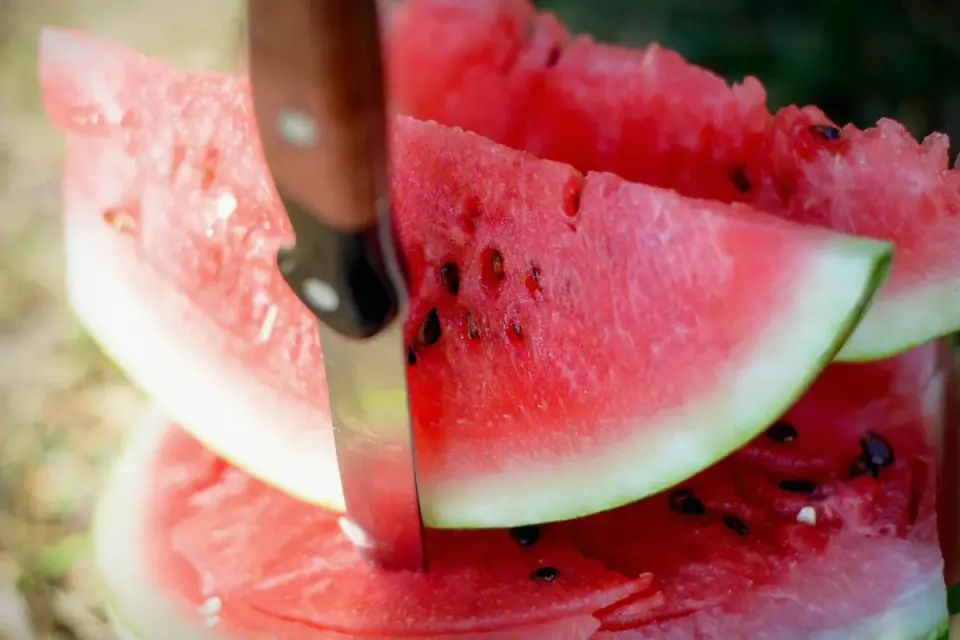
This is the part worth taking seriously. The rind is tough and fibrous enough that a dog’s digestive tract struggles to break it down, and larger pieces have caused intestinal blockages that required surgery. Seeds carry a smaller but real version of the same risk, plus a straightforward choking hazard in a dog that doesn’t chew before swallowing. Seedless watermelon still carries a scattering of small white seed coats, which are generally soft enough to pass, but I’d still trim the rind on a seedless melon exactly as carefully. The obstruction risk isn’t about seed color; it’s about anything tough and fibrous sitting in a gut that has to move it along.
The sugar question, and who actually needs to think twice
Watermelon carries more sugar per bite than a lot of dog-safe produce, and it sits at a glycemic index around 72 — high enough that a diabetic dog’s care team should weigh in before it becomes a regular treat, not an occasional one. For most healthy dogs at a sensible portion, that sugar load is a non-issue; a few small cubes isn’t the same math as a quarter of the melon. But an overweight dog training at a lower volume than Otis, or a dog with any endocrine diagnosis, is a different conversation, and it’s one your own veterinarian should have with you rather than a fruit guide.
Portion, and why more fiber isn’t automatically more gut health
I’ve watched a handler over-correct after a dog gets loose stool from too much melon — pulling the treat entirely and then adding a probiotic just in case, as though the two problems were the same thing. They usually aren’t. Most treat-related soft stool from watermelon is a volume and sugar issue that resolves by cutting the portion, not a dysbiosis that needs correcting. And probiotics themselves aren’t the tidy fix the label implies: in a recent trial, Frontiers in Veterinary Science reported that “diversity metrics did not distinguish non-responders from responders,” meaning even researchers can’t yet predict which dogs’ guts will actually shift with supplementation. That’s worth sitting with before you reach for a supplement to patch a portion-control problem.
Real pancreatic and digestive disease is a different category entirely, and it deserves real medical management rather than pantry fixes. Exocrine pancreatic insufficiency, for instance, is a genuine diagnosis, and per JAVMA, “EPI is treated by pancreatic enzyme replacement therapy, nutritional management (low-residue diets with moderate fat content), and supplementation of cobalamin.” That’s a veterinary treatment plan, not a fruit bowl decision — and it’s the kind of distinction that matters if a dog’s GI symptoms don’t track cleanly with what they ate. If loose stool follows a slice of watermelon and clears within a day, that’s portion. If it persists, that’s a vet visit, not a supplement aisle.
For dogs already managing joint load or recovering from a hard training block, the deeper gut-health picture is worth understanding on its own terms — see our guide to the diet and gut health connection in dogs for how fiber and the microbiome actually interact. And if fiber intake in general is a live question for your dog, how much fiber is too much covers where that line sits.

The honest bottom line
Watermelon earns its spot in a working dog’s summer rotation the same way sweet potato does — as a genuinely useful, low-risk treat when it’s prepared correctly, not as a wellness product. Compare the two and the tradeoffs are similar: both are safe in moderation, both cause problems mainly through overfeeding or an unremoved hazard, and neither substitutes for the fundamentals of hydration, portion control, and a vet relationship for anything metabolic. If you’re weighing other treat swaps for an active dog, our sweet potato guide walks through a similar decision tree with a starchier ingredient. Otis gets his watermelon, seeds pulled, rind trimmed, portion sized to a working dog rather than a couch dog — and that’s really the whole standard worth holding.
Frequently asked questions
Can dogs eat watermelon rind at all?
Not in any meaningful amount. The rind is fibrous and tough to break down, and it's implicated in real cases of gastrointestinal blockage, which sometimes needs surgery to resolve. Trim it off before the flesh goes anywhere near your dog.
Is watermelon safe for a diabetic dog?
Only with your veterinarian's input. Watermelon carries more sugar per bite than many low-glycemic produce options, and a diabetic dog on insulin needs predictable, vet-cleared carbohydrate timing rather than an ad hoc slice.
How much watermelon can a healthy dog have?
Small cubes, seeds and rind removed, kept well under 10% of the day's calories. For most dogs that's a few bite-sized pieces, not a wedge.
Sources
- Can Dogs Eat Watermelon? Is Watermelon Safe for Dogs? — American Kennel Club
- Can Dogs Eat Watermelon? Benefits and Risks — PetMD
- Exocrine pancreatic insufficiency in dogs and cats — Journal of the American Veterinary Medical Association (JAVMA)
- Probiotic response variability in dogs — Frontiers in Veterinary Science