The Diet and Gut Health Connection in Dogs: How Food Shapes the Microbiome
Medically reviewed by Joyce Gerardi, DVM, CVA, CVCH, CVFT, MSTCVM — For general education — not a substitute for veterinary care.
The diet and gut health connection in dogs runs through fiber, fermentation, and the microbes that turn food into fuel.
On this page
- The Gut as Part of the Recovery Picture
- How Diet Actually Shapes the Microbiome
- Short-Chain Fatty Acids: The Currency of Gut Recovery
- What a Fiber-Blend Trial Found in Senior Dogs
- Where Probiotics Fit — and Where the Evidence Is Still Narrow
- Reading the Signs Between Meals
- Building a Gut-Supportive Feeding Plan
- The Bottom Line
Ask a canine sports-medicine team how a working dog recovers between sessions, and the conversation almost always circles back to two things: what the dog eats, and how well the gut turns that food into usable fuel. The diet and gut health connection in dogs isn’t a vague wellness idea — it’s a mechanical one, built on named bacterial strains, measurable doses, and metabolites you can track in a fecal sample. Treat the gut the way you’d treat any other recovery system: it needs the right fuel, the right rest, and a microbial population that’s doing its job.
The Gut as Part of the Recovery Picture
In load-management terms, a working or sporting dog’s joints get the attention — tissue tolerance, recovery windows, training volume. The gut deserves the same framing. It’s the system converting a bowl of food into the glucose, fatty acids, and amino acids that rebuild tissue after exertion, and it does that job through a dense community of resident bacteria that ferment what the dog’s own enzymes can’t break down. When that community is off — through a diet swap made too fast, a course of antibiotics, or simple age — the signs show up exactly where you’d expect: stool quality, appetite, and how quickly a dog bounces back after a hard day.
How Diet Actually Shapes the Microbiome
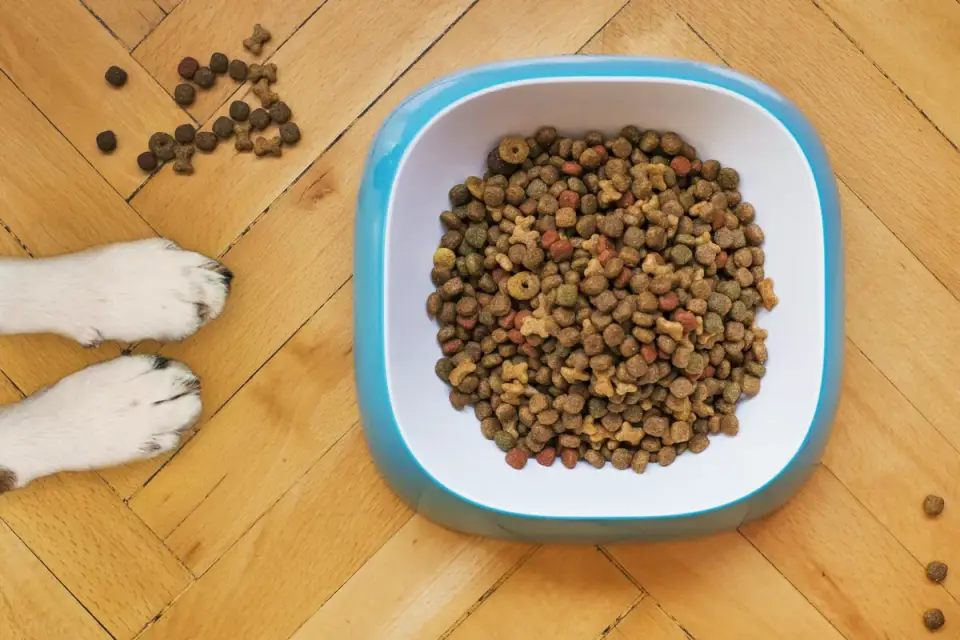
Diet is the single biggest lever on which bacteria dominate a dog’s gut, and the mechanism is straightforward: macronutrient ratios select for different bacterial populations. A 2019 review in Frontiers in Veterinary Science by Pilla and Suchodolski lays out the pathway — diets higher in protein favor Clostridiaceae species that ferment amino acids for energy, while diets higher in fermentable fiber favor Firmicutes that ferment carbohydrate instead. Neither is inherently better; the point is that the ratio on the label is doing real, measurable work on the population living in the colon, not just passing through.
That’s why abrupt diet changes cause loose stool even with a “good” new food — the resident microbial population hasn’t had time to shift toward the new substrate. A gradual transition, generally stretched over a week or more, gives the fermenting bacteria time to catch up rather than leaving undigested material to ferment unpredictably.
Short-Chain Fatty Acids: The Currency of Gut Recovery
The output of that fermentation is a family of short-chain fatty acids (SCFAs) — acetate, propionate, and especially butyrate. Butyrate is, per Pilla and Suchodolski, “the preferred energy source for colonocytes,” meaning the cells lining the gut wall run on it directly rather than pulling fuel from the bloodstream. That has a downstream effect on barrier integrity: a well-fed gut lining is a tighter one, which is part of why fiber and fermentable-carbohydrate intake track so closely with stool quality.
SCFAs also appear to shape immune tone in the gut. The same review notes that certain Clostridium clusters associated with fiber fermentation “stimulate the induction of [regulatory T cells]” — a calming signal in the gut’s immune tissue. None of this means more fiber is automatically better for every dog; it means the fermentation byproducts of a well-matched diet are doing physiological work, not just moving through.
What a Fiber-Blend Trial Found in Senior Dogs
Mechanism aside, the practical question is whether feeding a specific fiber source changes outcomes owners can actually see. A 2023 trial in Animals, Le Bon et al., tested a prebiotic fiber blend (sugar beet pulp, galacto-oligosaccharides, and cellulose, roughly 2:7) fed as a topper to 32 senior dogs across three breeds. The blend “reduced the incidence of poor faeces further, with a significantly lower proportion of faecal scores classed as poor when dogs received the prebiotic fibre blend (0.3%) compared to the control (1.5%).” Fecal pH dropped significantly too, and branched-chain fatty acids — a marker of bacteria fermenting protein rather than fiber, generally the less desirable pathway — fell. On the microbiome side, Lactobacillus and Bacteroides increased while Escherichia/Shigella declined. It’s one trial, in older dogs specifically, but it’s a rare case where the mechanism (more fermentable fiber, fewer protein-fermenting byproducts) lines up with an outcome an owner would actually notice in the yard.
Where Probiotics Fit — and Where the Evidence Is Still Narrow
Probiotics are a live extension of the same idea: instead of feeding the resident bacteria, you’re adding named strains directly. A single-arm, open-label pilot study in Frontiers in Veterinary Science followed 11 client-owned adult dogs with chronic diarrhea given a novel probiotic containing three canine-derived strains: “1E7 CFU/g Peptacetobacter hiranonis ASCUSCA136, 1E5 CFU/g Megamonas funiformis ASCUSCA104, and 1E7 CFU/g Enterococcus faecium ASCUSCA103,” dosed at “a fixed dose of ¼ tsp (0.70 g) for patients weighing less than 40 pounds and ½ tsp. for patients weighing 40 pounds or more.” The study reports that “no adverse events were noted in any dogs receiving the AMP,” and situates the mechanism in line with what’s known about probiotics generally: they “have been shown to improve barrier function and help modulate the number of mucosal bacteria, maintaining mucosal homeostasis,” and “can influence immune activity, produce antimicrobial compounds, and promote normalization of host microbiota.”
The honest caveat, in the same rigorous spirit this evidence deserves: this was a small, single-arm pilot with no control group, in dogs already experiencing diarrhea under veterinary care — not a study of daily probiotic use in an otherwise healthy dog. It supports the mechanism and the tolerability of these specific strains at these specific doses; it doesn’t license a blanket claim that any probiotic, at any dose, does the same thing for every dog. A dog’s diet and gut health connection is strain- and dose-specific, and a veterinarian is the right person to match a product to what’s actually going on.
Reading the Signs Between Meals
None of this requires a lab test to start paying attention. Loose or inconsistent stool that tracks with a recent food change, gas, a dog that’s slower to settle after meals, or a coat that’s lost some of its shine can all be downstream of a gut population under strain. None of these signs point to a single cause on their own — that’s precisely why a veterinary exam, not a supplement aisle, is the right next stop when they show up together or persist.
Building a Gut-Supportive Feeding Plan
The practical version of all this research is unglamorous: feed a consistent diet, transition between foods gradually, and choose fiber sources with some evidence behind them rather than whatever is cheapest on the shelf that week. From a food-therapy perspective, it also helps to think of the bowl as one input among several in a dog’s whole-patient picture — rest, activity, and stress all interact with digestion, not just the ingredient panel. If you do add a probiotic or fiber supplement, a product carrying the NASC Quality Seal at least signals that the manufacturer has passed an independent audit of its quality-control and labeling practices, which is a reasonable floor to check for before dose or strain even enters the conversation.
The Bottom Line
The diet and gut health connection in dogs is no longer a matter of instinct — it’s traceable through macronutrient ratios, fermentation byproducts, and, in a handful of well-designed trials, named strains and doses with observable effects on stool quality and microbial composition. Feed deliberately, change food slowly, and loop in your veterinarian before layering on a supplement — the science is specific enough now that “digestive support” should mean something you can actually point to.
Frequently asked questions
How does diet affect a dog's gut health?
Diet is the biggest lever on which bacteria dominate a dog's gut. Higher-protein diets favor bacteria that ferment amino acids, while higher-fiber diets favor bacteria that ferment carbohydrate instead, per a 2019 review in Frontiers in Veterinary Science. That fermentation produces short-chain fatty acids like butyrate, which colonocytes (the cells lining the gut) use directly as fuel.
What foods or fibers support a healthy gut microbiome in dogs?
Fermentable fiber sources are the best-studied lever. A 2023 trial in Animals found a prebiotic fiber blend (sugar beet pulp, galacto-oligosaccharides, and cellulose) fed to senior dogs significantly reduced the incidence of poor stool scores and shifted the microbiome toward more Lactobacillus and Bacteroides and less Escherichia/Shigella.
Can probiotics help a dog's digestion?
A small pilot study followed 11 dogs with chronic diarrhea given a probiotic with three named canine-derived strains at specific doses (1E7 CFU/g Peptacetobacter hiranonis, 1E5 CFU/g Megamonas funiformis, 1E7 CFU/g Enterococcus faecium) and reported no adverse events. It was a single-arm study in dogs already under veterinary care for diarrhea, not a test of everyday probiotic use in healthy dogs, so a veterinarian should guide which strain and dose actually fits your dog.
How quickly should I switch my dog's food to protect gut health?
Gradually. The resident bacterial population needs time to shift toward a new substrate, so an abrupt switch commonly causes loose stool even with a high-quality new food. A transition stretched over a week or more gives the fermenting bacteria time to catch up.
Sources
- Pilot study evaluating tolerability and changes in fecal microbiota associated with novel probiotic administration to dogs with diarrhea — Frontiers in Veterinary Science
- The Role of the Canine Gut Microbiome and Metabolome in Health and Gastrointestinal Disease — Frontiers in Veterinary Science
- A Novel Prebiotic Fibre Blend Supports the Gastrointestinal Health of Senior Dogs — Animals (Basel) / PMC
- NASC Quality Seal — National Animal Supplement Council — National Animal Supplement Council