Standard vs Miniature Dachshund: What Size Actually Changes for Spine Health
A dachshund's disc risk is fixed by conformation, not by whether the scale reads eleven pounds or twenty-eight.

On this page
The first dachshund I ever treated for a disc flare was a nine-year-old miniature named Gus, twelve pounds, who’d jumped off an ottoman on a Tuesday morning and yelped once, then went quiet and wouldn’t take the stairs that evening. His owner asked me the question I hear from almost every dachshund owner in that exam room, in one form or another: would a standard have been safer? I understood the instinct — bigger dog, sturdier build, less like carrying a slinky on four legs. But it’s the wrong axis. Gus’s spine and a 28-pound standard’s spine are built from the same blueprint: an elongated thoracolumbar column sitting over legs that were bred short on purpose. The size class on the registration papers tells you almost nothing about which dog is more likely to end up on my table with a disc problem. What tells you something is what that spine is asked to do every day, for years, before anyone notices a problem.
Two Sizes, One Skeleton
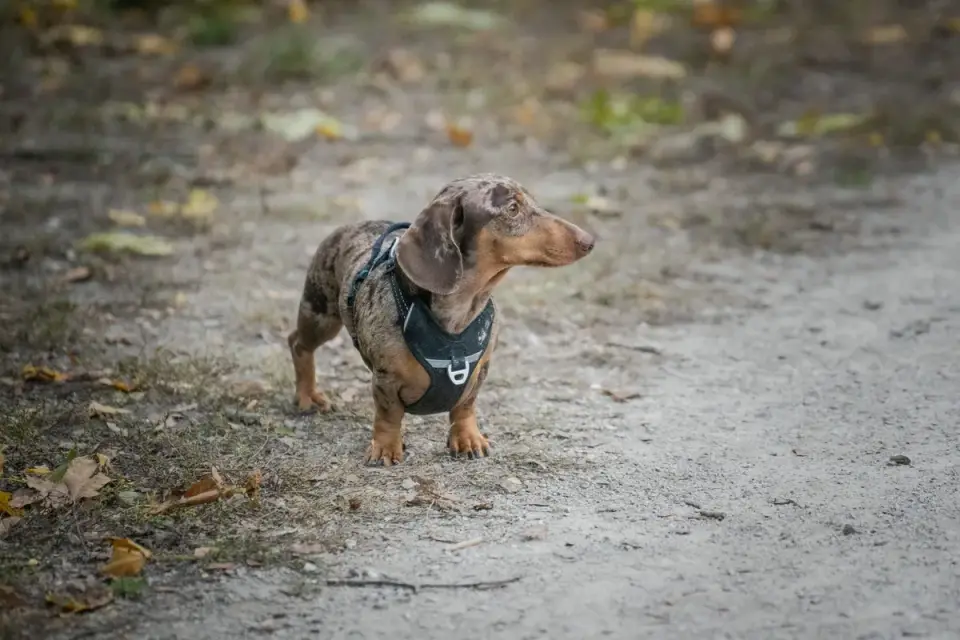
The split between standard and miniature dachshund is a weight and circumference distinction, not a different architecture. The American Kennel Club: AKC breed standard puts miniatures in a separate showing division for dogs 11 pounds and under at 12 months of age or older, while standards typically run 16 to 32 pounds at maturity. Both varieties are bred to the same silhouette: a long ribcage, minimal leg length, and a chondrodystrophic build that shortens the limbs relative to the spine. That’s the same skeletal category that produces early disc calcification in both sizes — the miniature isn’t a scaled-down standard with a different risk profile, it’s the same conformation packed into a smaller frame.
That shared architecture is why load-based thinking, not size-based thinking, is the more useful lens for owners. A dachshund’s intervertebral discs are working against a longer lever arm than a proportionally-built dog’s discs, size class aside. What changes the odds of a flare isn’t the number on the scale. It’s daily decisions: how many times a day the dog is allowed to load its spine in extension or torsion, how much of its lean body mass is muscle versus fat, and how consistently it gets moderate, low-impact activity instead of long stretches of inactivity punctuated by sofa leaps.
What the Disc Disease Data Actually Shows
Intervertebral disc disease (IVDD) is the defining orthopedic risk in this breed, and it’s substantial: dachshunds carry a relative risk of IVDD roughly 10 to 12 times higher than the general dog population, according to the UFAW welfare assessment of the breed, with an estimated 19 to 24% of dogs showing clinical signs during their lifetime. The largest lifestyle study on this, DachsLife 2015: an investigation of lifestyle associations with the risk of intervertebral disc disease in Dachshunds, surveyed 2,031 dogs and found overall IVDD prevalence of 15.7% — but the breakdown by coat variety and size didn’t hand size a clean verdict. Prevalence was highest in Standard Smooth-Haired dogs and lowest in Standard Wire-Haired dogs in that sample, which argues against “smaller is safer” as a reliable rule.
The same study flagged modifiable factors that mattered more than size: dogs exercised less than 30 minutes a day, or restricted from jumping on and off furniture, had increased odds of IVDD, while dogs getting more than an hour of daily activity and rated as moderately or highly active by their owners had decreased odds. Age and neuter status also showed up as risk factors in a separate retrospective analysis, Neuter status as a risk factor for canine intervertebral disc herniation (IVDH) in dachshunds: a retrospective cohort study, which is a conversation worth having with your own veterinarian rather than settling from a single article. None of this data sorts cleanly by “standard” versus “miniature.” It sorts by conditioning, body condition, and how the dog’s spine is loaded across an ordinary week.
The Load-Management Case File
I had a standard dachshund patient a few years back, Otis, six years old and a lean 26 pounds, whose owner ran him on a loose daily routine: a 20-minute leash walk most mornings, unrestricted furniture access, and long weekend stretches indoors when the weather turned. Over about four months I watched a pattern emerge that I now recognize immediately — subtle reluctance to take stairs he used to bound up, a slightly arched posture at rest, and a stiffness after naps that eased within a few minutes of moving. None of it was dramatic enough for an emergency visit. That’s exactly the profile that concerns me most, because early disc changes in this breed rarely announce themselves with a single alarming event. They accumulate as small, easy-to-explain-away shifts in an otherwise normal-looking dog, and by the time an owner calls about a yelp, the tissue has usually been under strain for a while.
What Otis’s case underscored for me wasn’t about his size at all — it was about training load in the sports-medicine sense: total daily activity, the ratio of controlled movement to uncontrolled impact, and recovery time between bouts of exertion. A standard dachshund doing unrestricted stair sprints and couch-launching is not automatically safer than a miniature on a structured routine, and the DachsLife 2015 data backs that up. Any exercise or activity change for a dog already showing these signs belongs in a conversation with your veterinarian or a canine sports-medicine specialist — this isn’t a do-it-yourself training call, it’s a diagnosis-driven one.
Recovery Isn’t Just the Spine
Where this gets more interesting to me clinically is how much the same recovery-science thinking applies below the spine, to gut and joint support broadly. A dog managing intervertebral disc risk is also often managing weight, medication tolerance, and mobility, and all three interact with digestive resilience. Consistent stool quality and predictable digestion make it easier to keep a recovering dog on a stable feeding and activity schedule, which is part of why our diet and gut health guide and our piece on fiber’s upper limit in dogs both matter more for this breed than owners tend to expect — a dog cycling through loose stool or GI upset is a dog whose activity and weight are both harder to hold steady, and weight is one of the few IVDD risk factors that’s fully within an owner’s control.
I also get asked often whether joint supplements belong in a young, asymptomatic dachshund’s routine before any signs appear. My honest answer is measured: the evidence for prevention in dogs without diagnosed disease is thinner than the evidence for management once a problem is identified, and it’s worth reading our joint supplement comparison with that distinction in mind rather than assuming every long-backed dog needs a chondroprotective product from puppyhood. Sweet potato and other novel-fiber ingredients come up often in dachshund-specific diet questions too, and our guide to sweet potato in active dogs covers where that ingredient genuinely helps versus where it’s just filler.

What I Tell Owners Choosing Between the Two
By the time an owner is choosing between a standard and a miniature dachshund puppy, I try to redirect the question toward something more useful than size. I ask what their home looks like — stairs, furniture height, whether there’s a yard or mostly hardwood floors — because that home environment will do more to shape spine outcomes over a decade than 15 pounds of adult body weight ever will. I’ve had families with standards who built ramps and kept a lean, active dog on a structured walking schedule and never saw a disc event by year ten. I’ve had families with miniatures who let every couch jump go unchecked and ended up in surgery consults before age five. Size buys you a slightly different silhouette and a different price tag on some medications dosed by weight. It does not buy you a materially different spine, and it does not exempt anyone from the daily load-management habits that actually move the needle: weight control, controlled exercise, and furniture or stair access matched to what that individual dog’s back can tolerate that week.
Frequently asked questions
Is a miniature dachshund less likely to get IVDD than a standard?
Not reliably. Large lifestyle studies of the breed have found prevalence varies more by coat type, body condition, and daily activity than by standard-versus-miniature size class.
What's the actual weight difference between the two varieties?
Miniatures compete in a class for dogs 11 pounds and under at maturity; standards typically weigh 16 to 32 pounds. Both share the same long-backed body plan.
Should I restrict my dachshund from jumping on furniture to protect its back?
Talk to your veterinarian before making that call. Some lifestyle data has linked furniture restriction with higher, not lower, IVDD odds, likely because it reflects owners already managing a symptomatic dog.
Does size affect how much a joint or gut supplement should cost per dose?
Dosing is typically weight-based, so a standard dachshund may need a different serving amount than a miniature; check the product label rather than assuming a flat dose across sizes.
Sources
- Official Standard of the Dachshund — American Kennel Club
- Dachshund - Intervertebral Disc Disease — UFAW
- DachsLife 2015: an investigation of lifestyle associations with the risk of intervertebral disc disease in Dachshunds — Companion Animal Health and Genetics
- Neuter status as a risk factor for canine intervertebral disc herniation (IVDH) in dachshunds: a retrospective cohort study — Companion Animal Health and Genetics