Is Kayaking Safe for Dogs? A Sports-Medicine Read on Load, Water, and Recovery
The real hazard in kayaking with a dog usually isn't the tipping — it's what the water and the sitting position quietly cost a joint.
On this page
- Is a Kayak or Canoe Actually a Big Ask for a Dog’s Body?
- How Should You Fit a Life Jacket So It Actually Does Its Job?
- What’s Actually in the Water, and When Do You Turn Around?
- How Do Ears and Coat Hold Up After Repeat Days on the Water?
- How Do You Structure the Day So Recovery Actually Happens?
- So Is Kayaking Worth It for a Dog?
A twelve-year-old Labrador named Otis taught me most of what I know about kayaking with dogs, though not in a classroom sense. His owner brought him in for a lameness recheck in late June, and almost as an aside mentioned they’d started taking him out on a reservoir near their house three evenings a week — nothing dramatic, twenty minutes of paddling with Otis braced low in the hull. Two weeks later she called because he was reluctant to jump into the truck bed. Nothing had shown up on exam. What had changed was posture: an aging dog holding a flexed, low-slung position against boat wake for twenty minutes at a stretch, several times a week, on top of his normal walks. That’s not a horror story. It’s a load problem, and load problems are usually fixable once you name them.
Is a Kayak or Canoe Actually a Big Ask for a Dog’s Body?
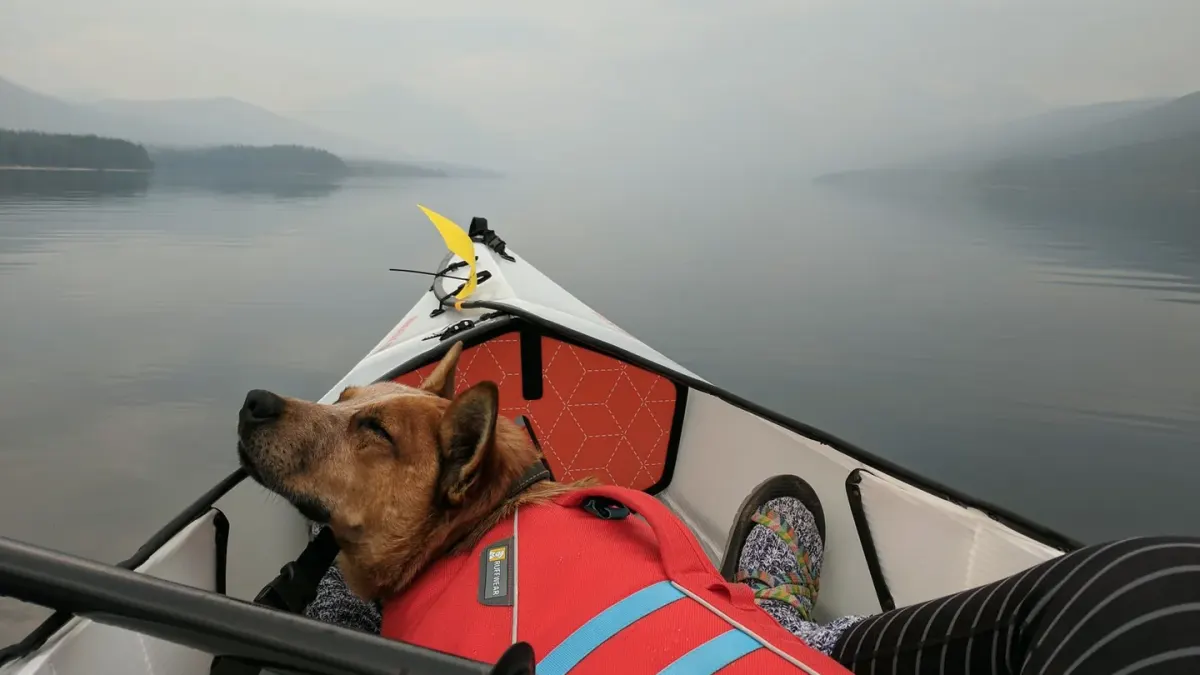
Yes, more than most owners expect, and less than most owners fear. A dog riding in a kayak isn’t swimming or running — it’s holding a static, often crouched position while absorbing wake, wind gusts, and its own attempts to reposition for balance. That’s isometric loading on the lumbar spine and hips, stacked on whatever exercise the dog already did that day. For a young, structurally sound dog, an hour of this is a minor addition to the week’s training volume. For a senior dog, a dog recovering from an orthopedic procedure, or a dog with existing hip or elbow disease, it’s a meaningful addition — the kind that belongs on the same tally sheet as a run or a hike, not treated as passive rest.
Small.
That’s the whole point: a “sit in the boat” day still counts as work.
How Should You Fit a Life Jacket So It Actually Does Its Job?
Buy for the dog’s actual girth and weight, not the breed chart. A jacket needs a snug chest strap, a belly strap that won’t ride forward under the front legs, and a rigid handle on top sturdy enough to lift a wet, panicking 60-pound dog straight out of the water — test the handle before you launch, with the dog in the jacket, by lifting slightly. Bright color matters for visibility against dark water more than it matters for style. Fit it a week or two before the first outing so the dog has already worn it on land and doesn’t associate the vest itself with stress.
What’s Actually in the Water, and When Do You Turn Around?
Two risks deserve more attention than fit does, and both are invisible until a dog is already sick. The first is leptospirosis. The American Veterinary Medical Association notes that slow-moving or stagnant water — the kind that fills most recreational lakes and marshy put-in spots — is a major transmission route, and the AVMA specifically advises against letting dogs drink from or swim in rivers, lakes, ponds, or stagnant water where exposure can’t be ruled out. Vaccination and a quick rinse-and-dry after any outing are the practical countermeasures; carrying fresh water for drinking removes the temptation entirely.
The second is cyanobacteria — blue-green algae. Cornell University’s Cornell University College of Veterinary Medicine: blue-green algae poisoning resource and the CDC’s guidance for veterinarians on harmful algal blooms both describe a toxin that can produce vomiting, tremors, or respiratory collapse within minutes to hours of exposure, with no antidote available — meaning prevention is the only real treatment. A visible scum, a paint-like sheen, or a green-tinted shoreline is reason enough to launch somewhere else that day. This isn’t a rare edge case for a paddling dog specifically; it’s the same lake risk every swimming dog faces, just with more exposure time because the dog is out on the water longer.
How Do Ears and Coat Hold Up After Repeat Days on the Water?
In my practice, floppy-eared dogs — Labradors, spaniels, setters — are the ones I end up treating for recurrent ear infections after a paddling season really gets going, not the pointy-eared breeds that shed water more easily. A dog’s L-shaped ear canal traps moisture rather than draining it, and repeated wetting without drying tips the canal toward the warm, damp environment bacteria and yeast prefer. I tell owners of water-loving dogs to dry the ear canal itself, not just the flap, after every outing, and to check weekly for redness, odor, or head-shaking that wasn’t there before. It’s a small habit that prevents a much bigger appointment later, and it costs nothing but a towel and ninety seconds.
How Do You Structure the Day So Recovery Actually Happens?
Treat a paddling day the way a strength coach treats a training day: load, then a real recovery window, not just “the dog slept.” That means a shorter walk than usual the next morning, a chance to check gait after the dog has rested rather than mid-outing when adrenaline masks stiffness, and attention to whether the dog is choosing to avoid the couch or the stairs afterward. Weigh what a supplement can realistically do for diet, mobility, and recovery in that picture, and be honest about the answer: joint supplements are not a substitute for managing how much load a dog absorbs in a week, and they won’t undo a fit or posture problem. What the better-supported ingredients can plausibly do is support the tissue that’s already being asked to work — which is why dose, sourcing, and third-party verification matter more than the ingredient list alone. Our sports-medicine picks and a closer look at whether hyaluronic acid actually holds up in the research go into what’s defensible and what isn’t. Gut health belongs in the same conversation, not a separate one — how diet shapes a dog’s microbiome affects how well a dog handles a physically demanding week, the same way fueling matters for a human athlete’s recovery.
I still remember a border collie named Scout, six years old, who paddled with her owner most weekends of one summer on a slow river outside town. By August the owner noticed Scout was slower to get up from lying down after the Sunday trips specifically, though fine on other days. Nothing structural showed up on exam; the pattern resolved once they built in a lighter Monday and started drying her ears and checking her gait the morning after, not the evening of. That’s the whole recovery-window idea in miniature: the outing itself was fine. What mattered was what happened in the 24 hours after it.
So Is Kayaking Worth It for a Dog?
For most healthy dogs, yes — with a properly fitted jacket, a hard no on stagnant or scummy water, and a recovery day built into the schedule the same way you’d build one in after a long hike. The dogs I’d hold back are seniors with existing joint disease, dogs recovering from surgery within the vet’s restricted window, and any dog whose owner can’t commit to drying ears and checking gait afterward. None of those dogs are automatically excluded from the water forever — just from an unmanaged version of it.
Frequently asked questions
Can dogs get sick from swimming in a lake while kayaking?
Yes. The two biggest water-quality risks are leptospirosis, which the AVMA links to slow-moving or stagnant water exposure, and blue-green algae blooms, which can cause rapid-onset vomiting, tremors, or worse. Avoid stagnant water and any visible scum or green sheen, and carry fresh drinking water so your dog isn't tempted by lake water.
What size life jacket does a dog need for kayaking?
Fit to your dog's actual chest girth and weight rather than a breed chart, and always test the top rescue handle by lifting the dog slightly before you launch, with the jacket already on.
How long can a dog safely sit in a kayak?
There's no universal number — it depends on the dog's age, joint health, and how much other exercise it's already done that week. Treat time in the boat as real training load, not passive rest, especially for senior or previously injured dogs.
Do dogs get ear infections from kayaking or canoeing?
Floppy-eared dogs are especially prone to this because their L-shaped ear canal traps moisture. Drying the ear canal after every outing and checking weekly for redness or odor helps catch it early.
Sources
- Leptospirosis in dogs — American Veterinary Medical Association
- Blue-green algae poisoning: Cyanobacteria toxicosis — Cornell University College of Veterinary Medicine
- For Veterinarians: Harmful Algal Bloom-Associated Illnesses — CDC