Do Goldendoodles Shed? What the Coat Genetics Actually Say
In my exam room the shedding question isn't about size or generation — it's which combination of two coat genes each doodle inherited, and that varies puppy to puppy.
On this page
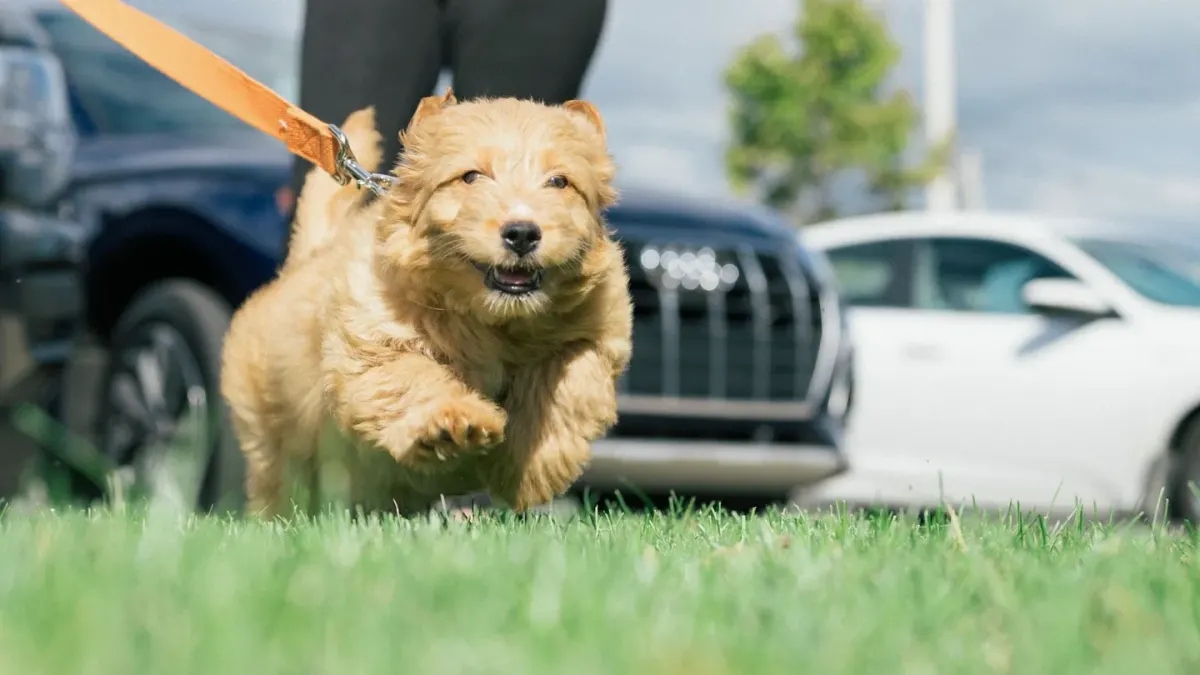
I had a client bring in two Goldendoodle littermates for their one-year wellness visits on the same afternoon last spring — a 55-pound male named Baxter and his sister, 48 pounds, same food, same house, same walks. Baxter’s owner spent twenty minutes describing a fur tumbleweed problem that started around month nine: fine golden hair on the couch, in the vents, worked into the rug pile no vacuum seemed to fix. His sister’s owner just laughed and said she’d never once found a stray hair on her black work pants. Same parents, same birthday, same first fourteen weeks of life. Different dogs entirely once you looked at the undercoat.
That contrast is the honest answer to whether Goldendoodles shed: some do, meaningfully, and some genuinely don’t, and the difference isn’t marketing — it’s DNA you can test for before you ever bring a puppy home.
The word “doodle” tells you nothing about shedding
A Goldendoodle is a cross between a Golden Retriever, a moderate-to-heavy shedder with a double coat, and a Poodle, a breed that grows hair continuously and sheds very little. Breeding two dogs together doesn’t blend their coats into one predictable middle ground — it deals out a mix of the genes each parent carries, and that mix can land anywhere on the spectrum, even within one litter.
The genetics were mapped out in a landmark 2009 study published in Science, which analyzed more than 1,000 dogs across 80 breeds and found that three genes — RSPO2, FGF5, and KRT71 — account for nearly all of the coat variation seen in purebred and mixed dogs. Those genes control furnishings (the mustache-and-eyebrow growth pattern), hair length, and curl. A separate, closely related pair of genes, RSPO2 and MC5R, is what most directly governs how much a dog actually sheds.
What each gene is doing under the coat
Here’s the short version I give owners in the exam room, without the genetics-lecture pacing.
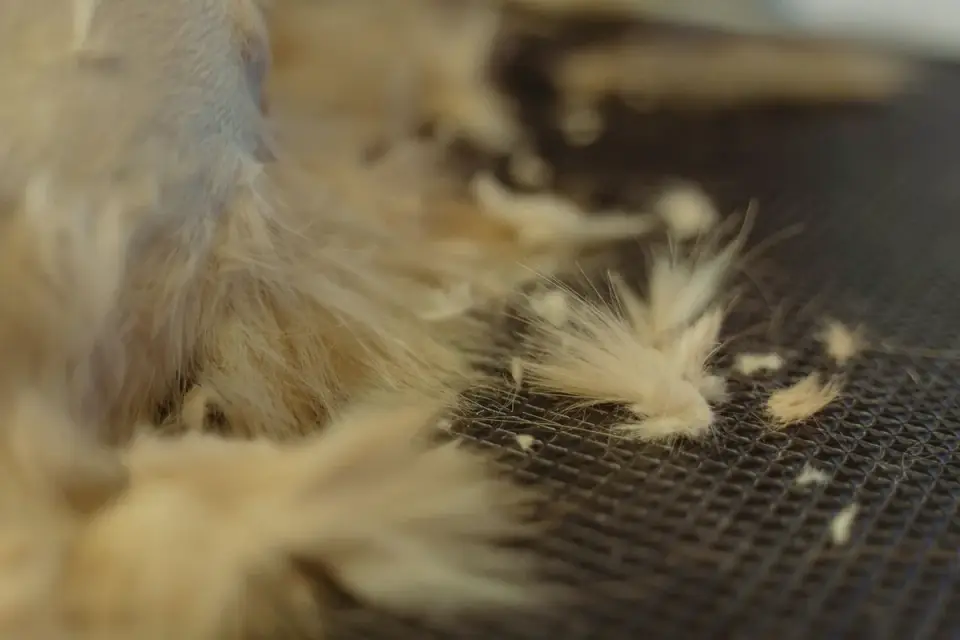
RSPO2 produces “furnishings” — that shaggy, bearded look people picture on a Poodle or a wire-coated terrier. According to Furnishings and Improper Coat: UC Davis’s Veterinary Genetics Laboratory, a dominant insertion near the RSPO2 gene produces this texture, and dogs carrying it tend to hold onto loose hair in the coat rather than dropping it around the house, in the same way a Poodle’s coat keeps growing instead of cycling out. A puppy with one copy of the furnishings variant will usually shed less than a littermate with none; two copies, less still.
MC5R works alongside it. Per UC Davis’s Shedding+ test description, a specific MC5R variant is independently associated with reduced shedding across multiple breeds, and the two genes have an additive effect — dogs carrying both low-shedding variants shed the least, dogs carrying neither shed the most, and everything in between falls somewhere on that curve. That’s why Baxter and his sister, with the same two parents, ended up on opposite ends of it: each inherited a different combination of these variants purely by chance, the same way two human siblings can end up with different eye colors from the same two parents.
Why “F1,” “F1b,” and “multigen” labels don’t settle it either
I get asked constantly whether a specific generation cross is the “safe” choice for shedding, and I understand the appeal — it feels like a shortcut. It isn’t a reliable one. An F1 Goldendoodle (first-generation Golden x Poodle) statistically carries a wider mix of coat genes because it’s drawing directly from two purebred gene pools. An F1b, bred back to a Poodle, shifts the odds toward more furnishings and less shedding on average, but “shifts the odds” is doing real work in that sentence — it is not a guarantee. I’ve examined F1b doodles that shed noticeably and multigenerational doodles that barely blow a coat at all, because generation labels describe a breeding pattern, not a genotype. The only way to know which coat genes a specific puppy actually carries is to test for them or, once the coat comes in around four to six months, to watch what it does.
A litter I worked with in a mobile clinic last fall made this obvious in one visit: five puppies, same parents, and by twelve weeks you could already sort them by feel — two with wiry, furnished faces that stayed cleaner-coated at their six-month recheck, one with a soft wavy coat that was shedding lightly into the exam table paper by month five, and two still too young to call. The breeder had Embark-tested the parents beforehand and could tell owners roughly what to expect per puppy going in, which is the single most useful thing a breeder can hand a family before a shedding-sensitive household commits.
What actually changes the day-to-day shedding load
None of this genetics detail changes basic coat maintenance, and I’d rather owners spend their energy there than chasing a generation label. A furnished, low-shedding doodle coat still mats without regular brushing — it just mats instead of shedding, which is arguably more work, not less. Dogs on the higher end of the shedding spectrum benefit from a consistent brushing routine and a diet that supports normal skin turnover; coat quality is tied to overall nutrition status, and that’s part of why we treat skin and gut health as connected systems rather than separate boxes to check, a theme we go deeper on in the diet and gut health connection in dogs. Coat development is also still moving through several stages in that first year — puppy fluff gives way to adult texture on its own timeline, something we map out more broadly in what to expect in a Labrador puppy’s first year, and doodle coats follow a similarly gradual, breed-specific version of that same process.
What to ask before you commit to a puppy
If shedding is a real constraint for your household — allergies, a dark-furniture apartment, a family member with asthma — ask the breeder whether the parents have been DNA-tested for furnishings (RSPO2) and shedding (MC5R), and ask to see the results rather than take a generation label at face value. A responsible breeder pairing low-shedding parents is working with better odds than chance alone, but I still tell every family the same thing I told Baxter’s owner at that recheck: meet the puppy, run your hands through the coat at eight weeks if you can, and understand that “doodle” was never a promise — the genes underneath it are.
Bottom line
Some Goldendoodles shed close to nothing; others shed enough to notice daily, and generation labels only nudge the odds — they don’t decide the outcome. If shedding matters to your household, ask for furnishings and shedding test results on the parents, and expect a real range even within one litter.
Frequently asked questions
Do all Goldendoodles shed at least a little?
Nearly all dogs shed some hair; the question is degree. Dogs carrying low-shedding variants of the RSPO2 and MC5R genes shed noticeably less, but very few doodles shed literally zero.
Is an F1b Goldendoodle guaranteed to shed less than an F1?
No. F1b breeding shifts the average odds toward more furnishings and lower shedding because of the extra Poodle parentage, but individual puppies still inherit a mix of variants, so exceptions in both directions are common.
Can I test a puppy's coat genetics myself?
Yes — commercial DNA panels can check for the RSPO2 furnishings variant and the MC5R shedding variant, and reputable breeders often test breeding parents before a litter is planned.
Sources
- Coat Variation in the Domestic Dog Is Governed by Variants in Three Genes — Science
- Shedding+ — UC Davis Veterinary Genetics Laboratory
- Furnishings and Improper Coat — UC Davis Veterinary Genetics Laboratory